
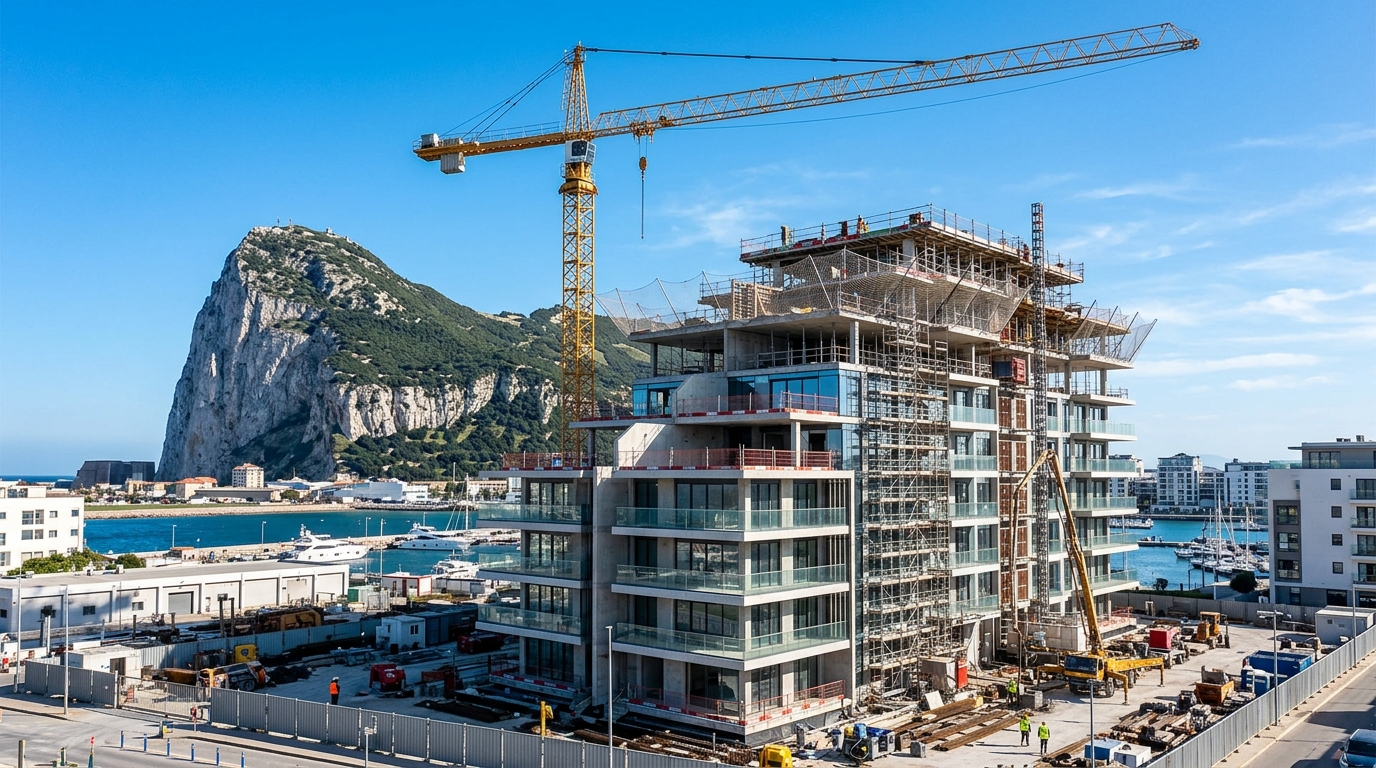
Buying off-plan in Gibraltar means committing to a property before construction finishes, typically paying staged deposits across a build period of 18 months to three years. The main appeal is early-bird pricing and first pick of units. The main risk is that Gibraltar has no statutory deposit protection scheme, making contractual safeguards and independent legal advice essential before signing anything.
Gibraltar's skyline is changing. Construction activity marks the Eastside reclamation, new towers are rising across the territory, and major regeneration projects are adding meaningfully to the housing stock. For buyers watching all this activity, one question keeps coming up: should you buy off-plan?
In a market as land-constrained as Gibraltar, where just 6.8 square kilometres must accommodate growing demand, off-plan purchases have become a significant part of the property landscape. But this is not a simple decision. There are real advantages and genuine risks that every buyer needs to understand before committing.
What Does "Off-Plan" Actually Mean in Gibraltar?
When you buy off-plan, you are purchasing a property based on architectural plans, CGI renders, and a developer's promise. You exchange contracts and pay deposits while the building is still under construction. The finished property could be months or even years away from completion.
In Gibraltar, off-plan purchases are particularly common because the territory has extremely limited developable land. Large-scale regeneration projects like the Eastside Development create dozens of new units at once, and developers typically sell a proportion off-plan to fund construction.
This is different from buying a completed new build where you can walk through the finished apartment before committing. Off-plan requires a leap of faith, backed by contracts and due diligence rather than physical inspection.
Why Are So Many People Buying Off-Plan in Gibraltar?
Below-market pricing. Developers typically offer early-bird pricing to fund construction. Buyers who commit during the pre-construction or early-build phase can often secure units at 5% to 15% below what the completed property will sell for on the open market.
Choice of unit and specification. Early buyers get first pick of floor plans, aspects, and floor levels. Many developers also allow buyers to customise finishes, layouts, and fixtures during construction, something impossible with resale properties.
Staged payments over time. Rather than finding the full purchase price upfront, off-plan buyers typically pay in stages across the construction timeline. This gives more time to arrange mortgage finance or build up savings before the final balance is due.
Modern specification. New builds come with contemporary kitchens, energy-efficient systems, modern insulation, and warranties. You avoid the hidden maintenance costs that older Gibraltar properties can carry.
Capital appreciation potential. If the market moves upward during construction (which can take 18 months to three or more years), the property could be worth significantly more by the time you collect the keys.
How Does the Deposit and Payment Structure Work?
Industry practice in Gibraltar typically follows a staged payment structure along these lines, though individual developments vary and you should always check the specific contract terms:
| Stage | Typical Payment | When It's Due |
|---|---|---|
| Reservation fee | ~2% of purchase price | On reservation (typically non-refundable) |
| Exchange of contracts | ~10% of purchase price | Once developer hits sales threshold |
| Substructure completion | ~9% of purchase price | Foundations complete |
| Superstructure completion | ~9% of purchase price | Frame or topping out complete |
| Final completion | ~70% of purchase price | On handover of keys |
This means you are putting down roughly 30% across the build period, with the bulk payable at completion. The reservation fee is almost always non-refundable. If you change your mind after reserving, you lose that amount. On a £500,000 apartment, a 2% reservation fee means £10,000 gone if you walk away.
What Are the Biggest Risks of Buying Off-Plan in Gibraltar?
No statutory deposit protection. Unlike Spain, which mandates bank guarantees for off-plan deposits, Gibraltar has no legal requirement for developers to protect your deposit. Protection is entirely contractual. If a developer goes bust and your deposit is not held in escrow or backed by a guarantee, you could become an unsecured creditor. Always ask exactly how deposits are held before signing anything.
Developer insolvency risk. Many Gibraltar developments are built through single-purpose vehicles (SPVs) with limited balance sheets. The parent company may be substantial, but the entity you are contracting with might have minimal assets beyond the development itself. Research the developer's track record and completion history, not just their brand name.
Construction delays. Delays are common in construction, and off-plan contracts often include broad force majeure clauses that let developers extend timelines. The critical protection here is the long-stop clause, which sets a final deadline for completion. Without one, you could be contractually bound indefinitely while the developer pushes completion further back.
Specification changes. What you see in the marketing suite may not be exactly what you get. Most contracts include "minor variation" and "material substitution" rights, meaning the developer can swap finishes, appliances, or materials for alternatives they consider equivalent. Get the specification schedule in writing and push for it to be as detailed as possible.
Mortgage valuation gaps. Your lender will value the property at completion, and their valuation might come in lower than the price you agreed months or years earlier. If that happens, you will need to bridge the gap with additional cash. This risk increases in flat or declining markets.
Assignment restrictions. Want to sell your off-plan contract before completion? Many developers require consent and charge assignment fees of 1% or more of the purchase price. Some contracts restrict assignment entirely. Check this before you buy, especially if you are treating it as a short-term investment.
Which Off-Plan Developments Are Active in Gibraltar Right Now?
Gibraltar has several significant developments at various stages. Here is an overview of the key schemes:
The Eastside Project
The largest regeneration project in Gibraltar's recent history. TNG Global paid a site premium of £90 million to the Government of Gibraltar in 2021 to develop approximately 14 hectares of reclaimed land on the eastern shoreline. The scheme plans around 1,300 residential units alongside a superyacht marina, hotel, retail, food and beverage, and public spaces.
The project is phased over a long horizon. Earlier completed development within the Eastside area, including the E1 luxury private residences, gives buyers a useful reference point for what finished eastside living looks like. Units from completed eastside schemes now appear on the resale market through agents including Chestertons Gibraltar and Savills Gibraltar.
Monument Plaza
Monument Plaza, developed by GMI Homes on Devil's Tower Road, is one of Gibraltar's most actively marketed current new-build schemes. It features a rooftop pool, gym, running track, and pickleball courts, with studios listed from £195,000 (as of early 2026). For buyers wanting a modern, amenity-rich building in the current market, this is one of the clearest active options to explore with agents such as GM International Homes.
EuroCity Gibraltar
EuroCity Gibraltar is a large mixed-use development on reclaimed land at the territory's northern end, with around 360 apartments as part of the wider scheme. It represents a significant addition to Gibraltar's housing stock within the northern regeneration zone.
Government Affordable Housing Schemes
Not all new construction in Gibraltar is aimed at the open market, and it is worth understanding the context. Hassan Centenary Terraces (HCT), six buildings ranging from 20 to 35 storeys on the eastern side overlooking Eastern Beach, is a Government 50/50 shared-ownership scheme delivering 665 units in total. Phase 1 (380 units) completed in 2023, with Phase 2 (285 units) to follow.
Bob Peliza Mews, on the North Mole on the site of the former electricity generating station, provides 482 to 514 affordable family dwellings plus 83 elderly-specific rented flats through the Government's shared-ownership scheme. Phase 1 reached completion in March 2026. These are not open-market investments, but they shape the overall supply picture and affect resale values across the territory.
How Do Off-Plan Prices Compare to Resale Properties?
Based on public listings and industry estimates, here is a general comparison. These ranges are indicative and vary significantly by development, floor level, aspect, and specification:
| Property Type | Off-Plan (Indicative Range) | Resale (Indicative Range) |
|---|---|---|
| 1-bed apartment | £250,000 to £400,000 | £280,000 to £450,000 |
| 2-bed apartment | £350,000 to £600,000 | £380,000 to £680,000 |
| 3-bed apartment | £500,000 to £850,000 | £550,000 to £900,000+ |
| Luxury or penthouse | £800,000+ | £900,000+ |
Off-plan buyers typically save 5% to 15% compared to what the same unit would sell for once completed, but that discount compensates for the risks and waiting time involved. Waterfront and high-floor units command significant premiums at every stage.
What About Stamp Duty on Off-Plan Purchases?
Gibraltar's stamp duty rates apply to off-plan purchases just as they do to resale properties. The rates below apply following the Stamp Duties Amendment Act 2024, in force 23 December 2024. The rate structure depends on whether you qualify as a first or second-time buyer.
First and Second-Time Buyers
| Purchase Price Band | Rate |
|---|---|
| Up to £300,000 | 0% |
| £300,001 to £350,000 | 5.5% on this band |
| Above £350,000 | 3.5% on the balance |
Non-Qualifying Purchasers
| Purchase Price Band | Rate |
|---|---|
| Up to £200,000 | 0% |
| £200,001 to £350,000 | 2% on first £250,000 + 5.5% on balance |
| £350,001 to £800,000 | 3% on first £350,000 + 3.5% on balance |
| Above £800,000 | 3% on first £350,000 + 3.5% on next £450,000 + 4.5% on balance |
For a full breakdown of all property taxes in Gibraltar, read our complete guide to Gibraltar stamp duty and property taxes.
What Should You Check Before Buying Off-Plan?
1. Developer track record. Have they completed similar projects before? On time? To specification? Ask for references from previous buyers if possible.
2. Deposit protection. How are your deposits held? Insist on escrow, client accounts, or bank guarantees. If the developer will not offer any protection, that is a red flag.
3. Long-stop clause. Does the contract include a firm deadline for completion? What happens if the developer misses it? Can you walk away and recover your deposit?
4. Specification schedule. Get every detail in writing: kitchen brand, appliance models, flooring type, bathroom fittings. The more specific, the harder it is for the developer to substitute alternatives.
5. Assignment rights. Can you sell the contract if your circumstances change before completion? What fees apply?
6. Snagging process. What is the defect liability period after completion? Most developments offer 12 months for the developer to fix defects. Understand what is covered and how to report issues.
7. Service charge estimates. New builds with pools, gyms, and concierge services can carry substantial service charges. Get estimates in writing and understand what they cover before you commit.
8. Independent legal advice. Never use the developer's recommended solicitor. Get your own lawyer specialising in Gibraltar property law. Firms with active property practices include Hassans International Law Firm, ISOLAS LLP, Triay Lawyers, and TSN Law.
Is Off-Plan Right for You?
Off-plan buying makes the most sense if you:
- Are comfortable with a 12 to 36+ month wait for completion
- Want a modern, high-specification property with warranty coverage
- Have sufficient liquidity to cover staged deposits, typically 25% to 30% over the build period
- Can absorb the risk of a potential mortgage valuation shortfall at completion
- Are planning a long-term hold rather than a quick flip
- Have done thorough due diligence on the developer and contract terms
It is less suitable if you need to move in quickly, have tight finances with no buffer, or are uncomfortable with the lack of statutory deposit protections that Gibraltar's off-plan market currently offers.
For a broader look at whether Gibraltar property is a smart investment overall, see our ROI analysis for 2026.
Frequently Asked Questions
Can foreigners buy off-plan property in Gibraltar?
Yes. There are no restrictions on foreign nationals purchasing property in Gibraltar, whether off-plan or resale. Non-residents buy regularly, particularly for investment purposes. See our complete guide to buying property in Gibraltar for the full process.
What happens if the developer goes bankrupt during construction?
If your deposits are not protected through escrow or bank guarantees, you could lose them entirely. You would become an unsecured creditor in the developer's liquidation. This is why deposit protection should be your number one concern before signing. There is no statutory safety net in Gibraltar the way there is in Spain, so the contract is everything.
Can I get a mortgage for an off-plan property in Gibraltar?
Yes, but the mortgage is typically arranged closer to completion. Lenders will not release funds until the property is built and valued. You will need to fund deposits from your own resources during the build period. Lenders active in Gibraltar's residential mortgage market include NatWest International, Jyske Bank Gibraltar, and Gibraltar International Bank. Read our guide to mortgages in Gibraltar for more detail.
How long does off-plan construction typically take in Gibraltar?
Most developments take 18 months to 3 years from launch to completion. Larger phased schemes like the Eastside Project can take considerably longer. Always check the projected completion date and the long-stop clause in your contract before exchanging.
Do off-plan properties come with a warranty?
Most new builds in Gibraltar include a defect liability period of 12 months from completion, during which the developer is responsible for fixing construction defects. Structural warranties may extend further. Get warranty terms in writing before exchange.
Are there other taxes to budget for beyond stamp duty?
Gibraltar has no capital gains tax, no inheritance tax, and no wealth tax. There is also no VAT or GST. Buyers do pay annual Gibraltar Rates, a modest property charge that typically runs around £200 to £600 per year per residential unit (as of 2026). See our property taxes guide for a full breakdown.
This is not financial or legal advice. Property purchases involve significant financial commitments and risks. Always seek independent legal and financial advice before making any property investment decisions.